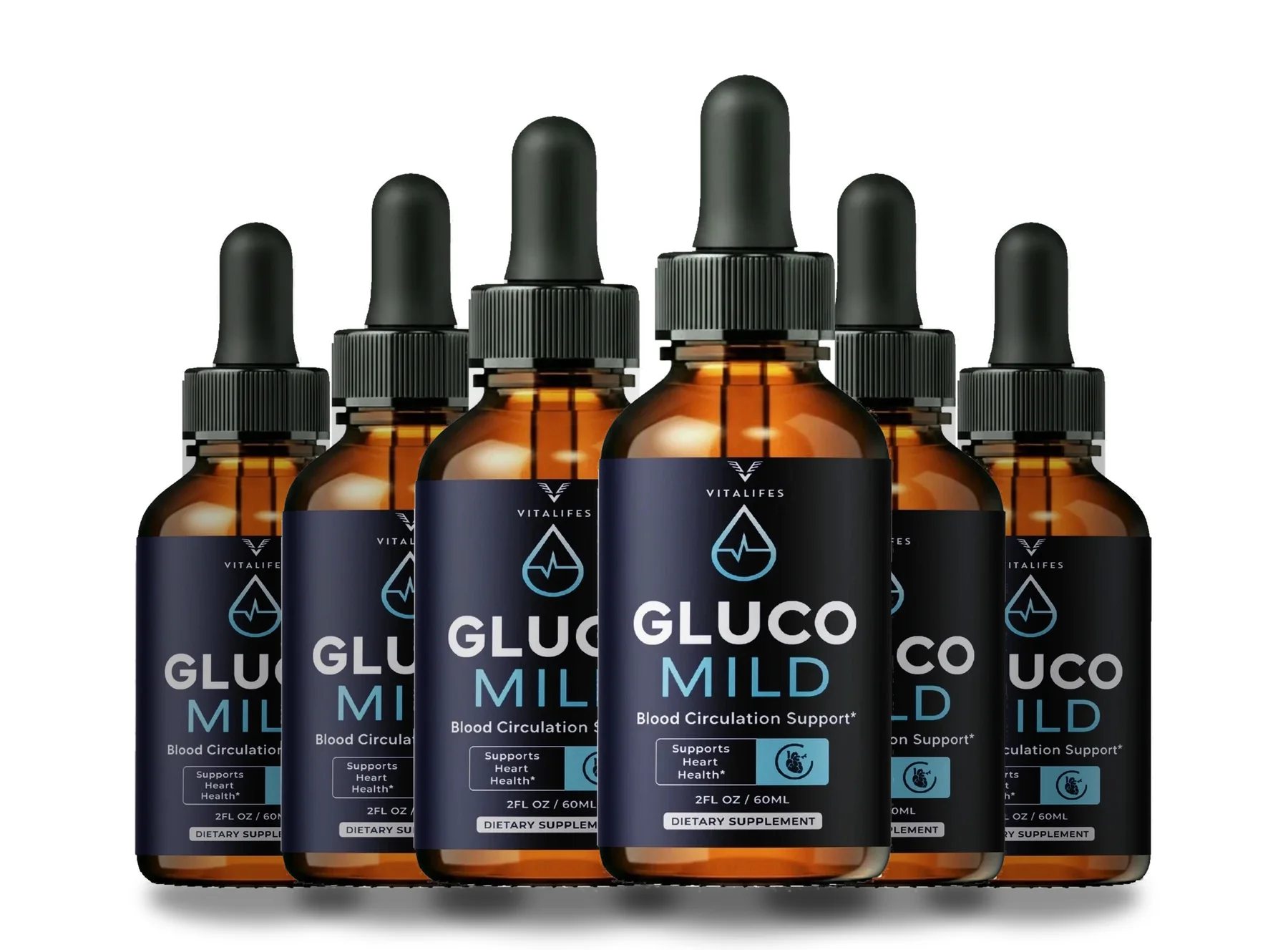
Gluco Mild Official Website › Ingredients
IngredientsGluco Mild Ingredients
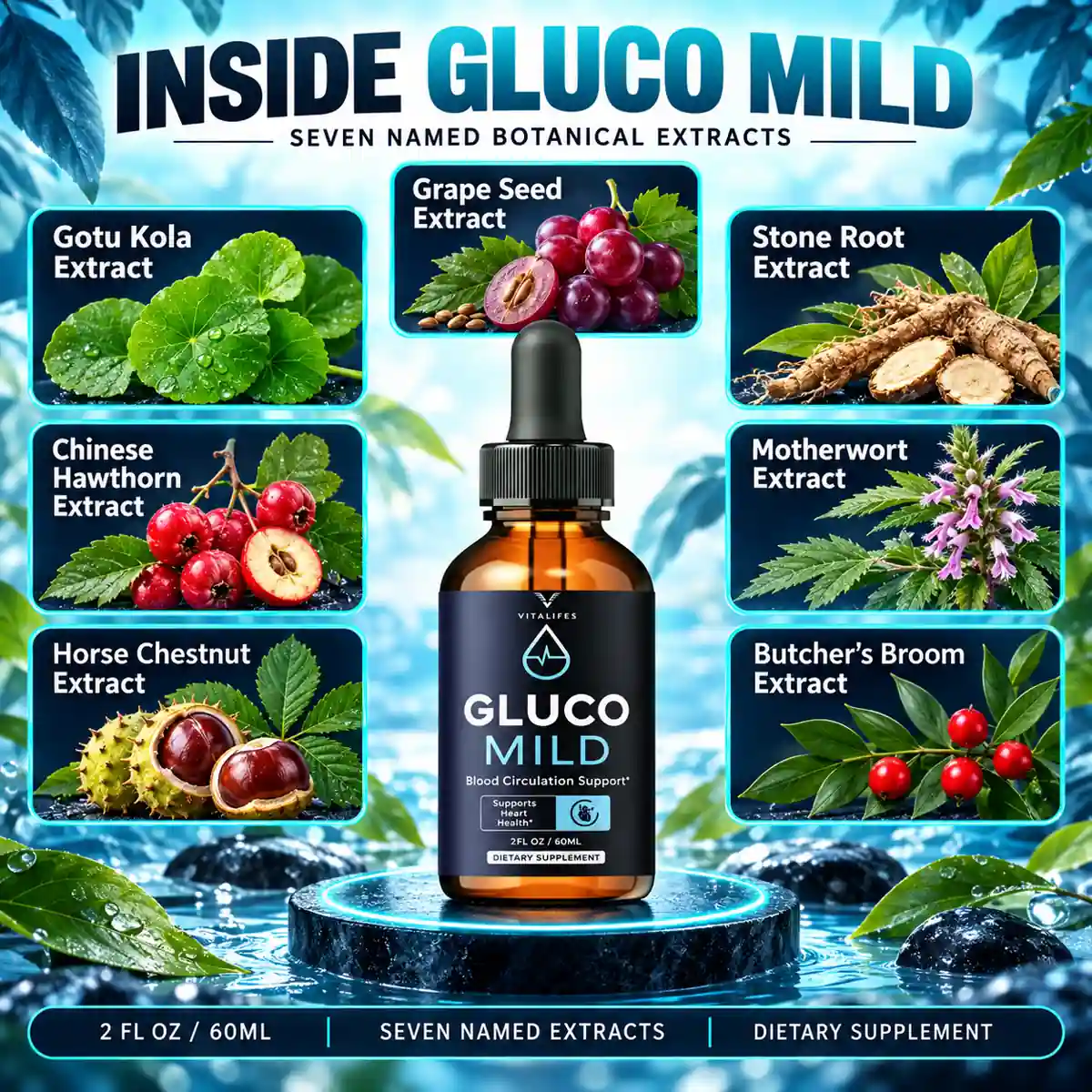
Seven botanical extracts are named on the Gluco Mild artwork: gotu kola, Chinese hawthorn, horse chestnut, stone root, motherwort, butcher’s broom and grape seed. Four carry a plant part in brackets. Five have human trials behind them and two rest on herbal tradition, and this page sorts them that way rather than alphabetically.
Every name on the artwork, and the material the research behind it actually used.
What are the Gluco Mild ingredients?
Seven names, four plant parts, and where each plant’s research lives.
Seven botanical extracts, in the order the seller’s ingredient artwork prints them. Four of the seven carry a plant part in brackets, which is more than a good deal of this category bothers with and is the reason several of the comparisons further down this page can be made at all.
| Printed on the artwork | Plant | Part named | Where its research sits |
|---|---|---|---|
| Gotu Kola Extract (leaf) | Centella asiatica | Leaf | Venous hypertension and capillary filtration |
| Chinese Hawthorn Extract (fruit) | Crataegus | Fruit | Exercise workload in chronic heart failure |
| Horse Chestnut Extract | Aesculus hippocastanum | Left open | Lower-leg volume in chronic venous insufficiency |
| Stone Root Extract (root) | Collinsonia canadensis | Root | Nineteenth-century practice, and nothing since |
| Motherwort Extract | Leonurus | Left open | Animal and cell pharmacology; one injection trial |
| Butcher’s Broom Extract (root) | Ruscus aculeatus | Root | Leg pain, heaviness and oedema, mostly in a combination |
| Grape Seed Extract | Vitis vinifera | Left open | Blood pressure and flow-mediated dilation |
Left column read off the seller’s ingredient artwork. The distributor’s own paperwork names the same seven plants in the same sequence.
Which Gluco Mild extracts have a standardised preparation behind them?
Gotu kola, horse chestnut and butcher’s broom, and the prepared material each one’s research actually used.
Three of the seven, and they are the three a venous formula is normally built on. Each has a body of human work, and in each case that work was done with a specific prepared material rather than with ground plant.
Gotu Kola Extract
Centella asiatica, leafStudied as a titrated triterpenic fractionCentella grows in wet ground across South and Southeast Asia and has a long kitchen and medicine-cabinet history in both. What reached the clinic is narrower than the plant: the venous studies used a titrated total triterpenic fraction, a concentrate assayed for asiaticoside, madecassoside and asiatic acid, given at 60 mg twice daily for eight weeks.
That material carried a placebo-controlled trial in venous hypertensive microangiopathy, a companion study built on a combined microcirculatory model, a long-haul flight study of ankle swelling and a study in diabetic microangiopathy. A dose-ranging arm compared 30 mg and 60 mg three times daily and the larger amount did more. The systematic review that pooled eight of these trials calls the direction consistent and the quality modest, and points out that most of the work comes from one group of investigators.
Horse Chestnut Extract
Aesculus hippocastanum, seedStudied as a seed extract assayed for aescinThe plant part matters here more than anywhere else on this list. NCCIH states that the raw seeds, bark, flowers and leaves of horse chestnut are unsafe taken by mouth because they contain a toxic component. The material used in the trials is a processed seed extract assayed for aescin, with the esculin taken out, and that processing is the whole difference between a studied supplement and a poisonous conker.
What that processed extract did is unusually concrete. A 1996 Lancet comparison set it against compression stockings and against placebo over twelve weeks at 50 mg of aescin twice daily, and the extract and the stockings reduced lower-leg volume by a similar amount. The Cochrane review of seventeen trials found reductions in leg pain, oedema, itching and calf circumference; a meta-analysis of thirteen trials and large observational series reached the same conclusion; and an earlier placebo-controlled oedema study and a criteria-based review sit underneath both. This artwork names the plant without naming the part or the assay, so a reader is trusting the maker on the point the research turns on.
Butcher’s Broom Extract
Ruscus aculeatus, rootStudied mostly inside a three-part capsuleA spiny Mediterranean shrub whose rhizome has been used for heavy legs for a very long time, and whose modern file has an awkward shape. Most of the evidence belongs to Cyclo 3 Fort, a capsule of Ruscus extract 150 mg with hesperidin methyl chalcone 150 mg and ascorbic acid 100 mg, so the result is a property of the combination rather than of the root on its own.
A meta-analysis covering 10,246 subjects found reductions in leg pain, heaviness and oedema, and a European Venous Forum symposium report went back over the graded evidence for it. The cleanest single-ingredient result is a twelve-week placebo-controlled trial of a Ruscus preparation alone, which reported reduced leg volume. Worth knowing alongside that: a case report proposed the same vein-tightening action as a way of treating orthostatic hypotension, so this is a compound with a measurable effect on vessels generally and not only on the ones that ache.
Which Gluco Mild extracts were studied at the heart end rather than the leg?
Hawthorn and grape seed, and the endpoints their trials were built to move.
Two, and they are the pair that earns the second line on the bottle. Their outcome measures are different from the venous three: exercise workload, systolic pressure and the way an artery widens when blood flow rises.
Chinese Hawthorn Extract
Crataegus, fruitStudied as WS 1442 at 1,800 mg a dayHawthorn berry is the most cardiological plant in this bottle and almost all of its clinical record belongs to one German preparation, WS 1442, standardised to oligomeric procyanidins. A sixteen-week comparison ran 900 mg and 1,800 mg a day against placebo in chronic heart failure: the larger arm improved maximal exercise workload and the smaller one did not. The Cochrane review pooled fourteen trials and found benefit on exercise tolerance and symptoms when it was added to standard treatment.
The later picture is more sober and belongs here rather than in a footnote. A two-year trial in 2,681 patients missed its primary cardiac endpoint, and a 2018 benefit-risk review reads the file as favourable on symptoms and neutral on hard outcomes. A crossover trial in prehypertensive adults looked at flow-mediated dilation. Two interaction findings travel with the plant: a controlled study with digoxin found no clinically meaningful change in digoxin levels, while a meta-analysis of the hawthorn and camphor combination found that particular pairing raises blood pressure by design. NCCIH’s page is the short version.
Grape Seed Extract
Vitis vinifera, seedStudied at 200 mg and 400 mg a dayThe most recently studied plant of the seven, and the one whose results are easiest to read because they are measured in millimetres of mercury. A 2019 randomised trial gave grape seed proanthocyanidin extract at 200 mg and at 400 mg a day for twelve weeks to adults with prehypertension; the 400 mg arm dropped systolic pressure by around 13 mmHg and improved endothelial function, and the 200 mg arm achieved less.
A dose-response meta-analysis pooled controlled trials of flow-mediated dilation, blood pressure and heart rate and found the effect real and related to the amount taken. A meta-analysis of sixteen randomised trials reported a modest systolic reduction and an earlier pooling of cardiovascular risk markers found the same shape. NCCIH keeps its own summary conservative. Of everything on this artwork, this is the extract that lines up most directly with a heart-health line.
Which Gluco Mild extracts are in the bottle on tradition?
Stone root and motherwort, and the difference between a long tradition and a trial.
Two, and naming them plainly is more useful to a buyer than borrowing a laboratory paper to cover the gap. Neither has an oral human trial at any amount, and this desk would rather say so beside the name than in small type at the foot of the page.
Stone Root Extract
Collinsonia canadensis, rootNo human trial at any amountA North American woodland mint whose knotty rhizome was a nineteenth-century standby for haemorrhoids and varicose veins. The entire human record in the medical literature is an 1887 note in the British Medical Journal and an 1888 note in a southern medical record. There has been no controlled study since, no dose-finding work, and no modern description of what it does in a person.
The laboratory file is short as well. A 1999 phytochemistry paper isolated a novel 2-hydroxyflavanone from the plant and a high-throughput screen included it among a long list of natural products tested against a breast carcinoma cell line. Neither describes a leg. Stone root is in this blend because herbalists have put it in this kind of blend for a century and a half, and a buyer is entitled to weigh that for exactly what it is.
Motherwort Extract
Leonurus cardiacaNo oral human trial at any amountA tall square-stemmed mint with a genuinely cardiotonic reputation. A review of cardiotonic plants groups Leonurus with foxglove relatives for that reason and is candid that the clinical work behind the group is thin. A review of the genus and a review of Herba Leonuri chemistry set out the alkaloids, leonurine and stachydrine among them, and the vascular effects recorded in animal and cell studies.
What is missing is a human study of the capsule-and-dropper kind. The one randomised controlled trial used a motherwort injection to reduce bleeding after an induced abortion: a different route, a different purpose and a different group of people. It is cited here because it is the honest answer to the question of what human evidence exists for this plant, and for no other reason. Motherwort also carries the reason this formula is unsuitable in pregnancy, which the side effects page sets out.
How should you read the Gluco Mild ingredient list?
Four things a botanical name can tell you, and how many of them this one does.
A botanical name on a label is four separate promises, and most labels keep two of them. Knowing which four they are turns an ingredient list from a mood into something you can interrogate, whatever bottle you are holding.
The plant, in Latin
A common name can cover several species. Reading “hawthorn” as Crataegus and “butcher’s broom” as Ruscus aculeatus is the first step, and this artwork supports it for every one of the seven, which is genuinely useful.
The part of the plant
Root, leaf, fruit and seed are different chemistry from the same organism. Four of these seven name a part in brackets. Horse chestnut, motherwort and grape seed leave it open, and for horse chestnut that is the point the safety literature turns on.
The preparation and its marker
Nearly every trial cited on this page used a concentrate assayed against a marker compound: the triterpenic fraction for gotu kola, aescin for horse chestnut, procyanidins for hawthorn. An artwork that names a plant has not yet named the substance the research tested.
The amount
The fourth promise is a weight, and this pack leaves it to the seller’s checkout to describe the product rather than printing a panel. What that means for each of the seven is set out in the honest dosage section on the home page, once, with the trial figures beside it.
An analysis by the Drug-Induced Liver Injury Network tested herbal and dietary supplements implicated in liver injury in the United States and found their contents were frequently mislabelled. That is an argument for buying from a seller who publishes a lot number you can quote back at them, which this one does, and for treating an ingredient list as a claim rather than as an assay. NCCIH’s guidance on using supplements wisely and the NIH Office of Dietary Supplements both make the same point in gentler language.
Gluco Mild ingredient questions
How many ingredients does Gluco Mild have?
Seven named botanical extracts. The seller’s ingredient artwork lists them and the distributor’s paperwork lists the same seven in the same order, so the two sources agree with each other exactly.
Does Gluco Mild contain anything for blood sugar?
No. None of the seven plants above has a blood sugar indication, the bottle’s own descriptor line is about circulation, and nothing on this website claims an effect on glucose, insulin or A1c. The home page deals with the name in full.
Is there a Supplement Facts panel on the Gluco Mild bottle?
Every bottle image the seller supplies is front-of-label, and the pack arrives without a carton or an insert. The ingredient artwork is the fullest statement of contents this product has, and it gives names rather than weights.
Is Gluco Mild vegan?
The seller makes no vegan, vegetarian, gluten-free or allergen statement, and the liquid’s carrier is not named on the artwork. All seven actives are plant extracts. Anyone avoiding a specific carrier such as glycerine or alcohol should ask the order desk before buying rather than assume.
Does the Gluco Mild list change between batches?
Nothing in the distributor’s paperwork suggests a reformulation, and lot GLU-26/GO-6518 is the batch this desk holds paperwork for. Compare the artwork against the bottle you receive and tell the order desk if the two disagree; the batch page explains how.
Which Gluco Mild ingredient has the strongest evidence?
Horse chestnut seed extract, measured against compression stockings rather than against nothing, with gotu kola close behind on capillary filtration. Grape seed has the most modern trial record of the seven.
Sources behind the Gluco Mild ingredient list
Grouped by the extract they belong to, in the order the artwork names it.
- Cesarone MR, Belcaro G, De Sanctis MT, et al. Effects of the total triterpenic fraction of Centella asiatica in venous hypertensive microangiopathy: a prospective, placebo-controlled, randomized trial. Angiology. 2001;52 Suppl 2:S15-18. PMID 11666117. https://pubmed.ncbi.nlm.nih.gov/11666117/
- De Sanctis MT, Belcaro G, Incandela L, et al. Treatment of edema and increased capillary filtration in venous hypertension with total triterpenic fraction of Centella asiatica: a clinical, prospective, placebo-controlled, randomized, dose-ranging trial. Angiology. 2001;52 Suppl 2:S55-9. PMID 11666125. https://pubmed.ncbi.nlm.nih.gov/11666125/
- Incandela L, Belcaro G, De Sanctis MT, et al. Total triterpenic fraction of Centella asiatica in the treatment of venous hypertension: a clinical, prospective, randomized trial using a combined microcirculatory model. Angiology. 2001;52 Suppl 2:S61-7. PMID 11666126. https://pubmed.ncbi.nlm.nih.gov/11666126/
- Cesarone MR, Incandela L, De Sanctis MT, et al. Flight microangiopathy in medium- to long-distance flights: prevention of edema and microcirculation alterations with total triterpenic fraction of Centella asiatica. Angiology. 2001;52 Suppl 2:S33-7. PMID 11666121. https://pubmed.ncbi.nlm.nih.gov/11666121/
- Incandela L, Belcaro G, Cesarone MR, et al. Treatment of diabetic microangiopathy and edema with total triterpenic fraction of Centella asiatica: a prospective, placebo-controlled randomized study. Angiology. 2001;52 Suppl 2:S27-31. PMID 11666119. https://pubmed.ncbi.nlm.nih.gov/11666119/
- Chong NJ, Aziz Z. A systematic review of the efficacy of Centella asiatica for improvement of the signs and symptoms of chronic venous insufficiency. Evid Based Complement Alternat Med. 2013;2013:627182. PMID 23533507. https://pubmed.ncbi.nlm.nih.gov/23533507/
- Pittler MH, Guo R, Ernst E. Hawthorn extract for treating chronic heart failure. Cochrane Database Syst Rev. 2008;2008(1):CD005312. PMID 18254076. https://pubmed.ncbi.nlm.nih.gov/18254076/
- Tauchert M. Efficacy and safety of crataegus extract WS 1442 in comparison with placebo in patients with chronic stable New York Heart Association class-III heart failure. Am Heart J. 2002;143(5):910-5. PMID 12040357. https://pubmed.ncbi.nlm.nih.gov/12040357/
- Holubarsch CJ, Colucci WS, Meinertz T, Gaus W, Tendera M. The efficacy and safety of Crataegus extract WS 1442 in patients with heart failure: the SPICE trial. Eur J Heart Fail. 2008;10(12):1255-63. PMID 19019730. https://pubmed.ncbi.nlm.nih.gov/19019730/
- Holubarsch CJF, Colucci WS, Eha J. Benefit-risk assessment of Crataegus extract WS 1442: an evidence-based review. Am J Cardiovasc Drugs. 2018;18(1):25-36. PMID 29080984. https://pubmed.ncbi.nlm.nih.gov/29080984/
- Tankanow R, Tamer HR, Streetman DS, et al. Interaction study between digoxin and a preparation of hawthorn (Crataegus oxyacantha). J Clin Pharmacol. 2003;43(6):637-42. PMID 12817526. https://pubmed.ncbi.nlm.nih.gov/12817526/
- Csupor D, Viczian R, Lantos T, et al. The combination of hawthorn extract and camphor significantly increases blood pressure: a meta-analysis and systematic review. Phytomedicine. 2019;63:152984. PMID 31255877. https://pubmed.ncbi.nlm.nih.gov/31255877/
- Asher GN, Viera AJ, Weaver MA, et al. Effect of hawthorn standardized extract on flow mediated dilation in prehypertensive and mildly hypertensive adults: a randomized, controlled cross-over trial. BMC Complement Altern Med. 2012;12:26. PMID 22458601. https://pubmed.ncbi.nlm.nih.gov/22458601/
- Hawthorn. National Center for Complementary and Integrative Health, National Institutes of Health. https://www.nccih.nih.gov/health/hawthorn
- Pittler MH, Ernst E. Horse chestnut seed extract for chronic venous insufficiency. Cochrane Database Syst Rev. 2012;11(11):CD003230. PMID 23152216. https://pubmed.ncbi.nlm.nih.gov/23152216/
- Diehm C, Trampisch HJ, Lange S, Schmidt C. Comparison of leg compression stocking and oral horse-chestnut seed extract therapy in patients with chronic venous insufficiency. Lancet. 1996;347(8997):292-4. PMID 8569363. https://pubmed.ncbi.nlm.nih.gov/8569363/
- Siebert U, Brach M, Sroczynski G, Berla K. Efficacy, routine effectiveness, and safety of horsechestnut seed extract in the treatment of chronic venous insufficiency. A meta-analysis of randomized controlled trials and large observational studies. Int Angiol. 2002;21(4):305-15. PMID 12518108. https://pubmed.ncbi.nlm.nih.gov/12518108/
- Pittler MH, Ernst E. Horse-chestnut seed extract for chronic venous insufficiency. A criteria-based systematic review. Arch Dermatol. 1998;134(11):1356-60. PMID 9828868. https://pubmed.ncbi.nlm.nih.gov/9828868/
- Diehm C, Vollbrecht D, Amendt K, et al. Medical edema protection - clinical benefit in patients with chronic deep vein incompetence. A placebo controlled double blind study. Vasa. 1992;21(2):188-92. PMID 1621440. https://pubmed.ncbi.nlm.nih.gov/1621440/
- Horse Chestnut. National Center for Complementary and Integrative Health, National Institutes of Health. States that the raw seeds, bark, flowers and leaves are unsafe taken by mouth because they contain a toxic component. https://www.nccih.nih.gov/health/horse-chestnut
- Shoemaker JV. Collinsonia canadensis. Br Med J. 1887;2(1396):712-3. PMID 20752052. https://pubmed.ncbi.nlm.nih.gov/20752052/
- Collinsonia canadensis. South Med Rec. 1888;18(4):136. PMID 36022907. https://pubmed.ncbi.nlm.nih.gov/36022907/
- Stevens JF, Ivancic M, Deinzer ML, et al. A novel 2-hydroxyflavanone from Collinsonia canadensis. J Nat Prod. 1999;62(2):392-4. PMID 10075799. https://pubmed.ncbi.nlm.nih.gov/10075799/
- Mazzio E, Badisa R, Mack N, et al. High throughput screening of natural products for anti-mitotic effects in MDA-MB-231 human breast carcinoma cells. Phytother Res. 2014;28(6):856-67. PMID 24105850. https://pubmed.ncbi.nlm.nih.gov/24105850/
- Orhan IE, Gokbulut A, Senol FS. Adonis sp., Convallaria sp., Strophanthus sp., Thevetia sp., and Leonurus sp. - cardiotonic plants with known traditional use and a few preclinical and clinical studies. Curr Pharm Des. 2017;23(7):1051-1059. PMID 27748195. https://pubmed.ncbi.nlm.nih.gov/27748195/
- Zhang RH, Liu ZK, Yang DS, et al. Phytochemistry and pharmacology of the genus Leonurus: the herb to benefit the mothers and more. Phytochemistry. 2018;147:167-183. PMID 29335190. https://pubmed.ncbi.nlm.nih.gov/29335190/
- Liu XH, Pan LL, Zhu YZ. Active chemical compounds of traditional Chinese medicine Herba Leonuri: implications for cardiovascular diseases. Clin Exp Pharmacol Physiol. 2012;39(3):274-82. PMID 22004449. https://pubmed.ncbi.nlm.nih.gov/22004449/
- Xia WT, Zhou H, Wang Y, et al. Motherwort injection in preventing post-abortion hemorrhage after induced abortion: a multi-center, prospective, randomized controlled trial. Explore (NY). 2020;16(2):110-115. PMID 31492552. https://pubmed.ncbi.nlm.nih.gov/31492552/
- Vanscheidt W, Jost V, Wolna P, et al. Efficacy and safety of a Butcher's broom preparation (Ruscus aculeatus L. extract) compared to placebo in patients suffering from chronic venous insufficiency. Arzneimittelforschung. 2002;52(4):243-50. PMID 12040966. https://pubmed.ncbi.nlm.nih.gov/12040966/
- Boyle P, Diehm C, Robertson C. Meta-analysis of clinical trials of Cyclo 3 Fort in the treatment of chronic venous insufficiency. Int Angiol. 2003;22(3):250-62. PMID 14612852. https://pubmed.ncbi.nlm.nih.gov/14612852/
- Kakkos SK, Bouskela E, Jawien A, Nicolaides AN. New data on chronic venous disease: a new place for Cyclo 3 Fort. Int Angiol. 2018;37(1):85-92. PMID 29063748. https://pubmed.ncbi.nlm.nih.gov/29063748/
- Redman DA. Ruscus aculeatus (butcher's broom) as a potential treatment for orthostatic hypotension, with a case report. J Altern Complement Med. 2000;6(6):539-49. PMID 11152059. https://pubmed.ncbi.nlm.nih.gov/11152059/
- Foshati S, Nouripour F, Sadeghi E, Amani R. The effect of grape (Vitis vinifera) seed extract supplementation on flow-mediated dilation, blood pressure, and heart rate: a systematic review and meta-analysis of controlled trials with duration- and dose-response analysis. Pharmacol Res. 2022;175:105905. PMID 34798267. https://pubmed.ncbi.nlm.nih.gov/34798267/
- Zhang H, Liu S, Li L, et al. The impact of grape seed extract treatment on blood pressure changes: a meta-analysis of 16 randomized controlled trials. Medicine (Baltimore). 2016;95(33):e4247. PMID 27537554. https://pubmed.ncbi.nlm.nih.gov/27537554/
- Feringa HH, Laskey DA, Dickson JE, et al. The effect of grape seed extract on cardiovascular risk markers: a meta-analysis of randomized controlled trials. J Am Diet Assoc. 2011;111(8):1173-81. PMID 21802563. https://pubmed.ncbi.nlm.nih.gov/21802563/
- Odai T, Terauchi M, Kato K, Hirose A, Miyasaka N. Effects of grape seed proanthocyanidin extract on vascular endothelial function in participants with prehypertension: a randomized, double-blind, placebo-controlled study. Nutrients. 2019;11(12):2844. PMID 31757033. https://pubmed.ncbi.nlm.nih.gov/31757033/
- Grape Seed Extract. National Center for Complementary and Integrative Health, National Institutes of Health. https://www.nccih.nih.gov/health/grape-seed-extract
- Navarro V, Avula B, Khan I, et al. The contents of herbal and dietary supplements implicated in liver injury in the United States are frequently mislabeled. Hepatol Commun. 2019;3(6):792-794. PMID 31168513. https://pubmed.ncbi.nlm.nih.gov/31168513/
- Using Dietary Supplements Wisely. National Center for Complementary and Integrative Health, National Institutes of Health. https://www.nccih.nih.gov/health/using-dietary-supplements-wisely
- Dietary Supplements: What You Need to Know. Office of Dietary Supplements, National Institutes of Health. https://ods.od.nih.gov/factsheets/WYNTK-Consumer/
Order Gluco Mild with the ingredient list in front of you
Seven named botanical extracts, two drops a day from a 2 fl oz / 60 ml amber dropper bottle, lot GLU-26/GO-6518 on the batch.
Price shown at the seller’s checkout · seller’s satisfaction money-back guarantee
Order Gluco Mild On The Official WebsiteTwo drops a day · 2 fl oz / 60 ml a bottle · lot GLU-26/GO-6518