Gluco Mild Official Website › Blog › Hawthorn
Hawthorn: Why The Heart Evidence Stops At The Knee
Hawthorn has a genuine randomised literature behind it, and almost none of it is about legs. It is about heart failure, at one specific standardised extract, at a dose that stopped working when the same trial halved it. Knowing exactly what it covers is what stops it being borrowed.
- The serious hawthorn trials are in chronic heart failure, not in venous or leg symptoms.
- They used one specific standardised extract rather than hawthorn generally.
- In the dose comparison, 1,800 mg a day beat placebo on exercise workload and 900 mg a day of the same extract did not.
- Cochrane found benefit on symptoms and exercise tolerance in heart failure, from a body of trials in supervised populations.
- Two interaction findings matter: a digoxin study, and a meta-analysis showing hawthorn combined with camphor significantly raises blood pressure.
What the hawthorn evidence actually covers
Crataegus has been used in European medicine for a long time and, unusually for a traditional plant, it has been taken seriously enough to be put through large randomised trials. Those trials have a specific subject.
They are about chronic heart failure: people with a diagnosed cardiac condition, generally in New York Heart Association class II or III, usually taking conventional therapy alongside the extract, and monitored while they do it.
That is a long way from a healthy adult with heavy legs at the end of a standing shift, and the distance is worth mapping rather than gesturing at.
| Question | What the hawthorn evidence covers | What it does not |
|---|---|---|
| Which condition | Chronic heart failure, mostly NYHA class II and III | Chronic venous insufficiency, varicose veins or ankle oedema |
| Which outcomes | Exercise tolerance, symptom scores, workload | Leg volume, heaviness, evening swelling |
| Which preparation | One standardised extract, named in the trials | Hawthorn fruit, powder or an unspecified extract |
| Which dose | 1,800 mg a day in the successful arm | Any smaller amount, on this trial's own evidence |
| Which population | People with a diagnosed cardiac condition, under supervision | Healthy adults taking a supplement without supervision |
Five columns of distance between a real body of evidence and the use it is most often put to on a supplement label.
The dose comparison worth memorising
If one experiment in this whole field deserves to be remembered by anyone reading supplement labels, it is this one.
The comparison of the standardised extract WS 1442 against placebo in chronic stable heart failure ran for sixteen weeks and tested more than one amount. At 1,800 mg a day the extract beat placebo on exercise workload. At 900 mg a day, in the same trial, it did not.
| Arm of the comparison | Daily dose | What happened |
|---|---|---|
| The higher-dose arm | 1,800 mg a day of the standardised extract, 16 weeks | Beat placebo on exercise workload |
| The lower-dose arm | 900 mg a day of the same extract, same period | Did not separate from placebo |
| Placebo | None | The comparator |
One trial, one extract, one protocol. Halving the dose removed the result, which is the clearest argument for printed amounts anywhere in this literature.
Everything about that comparison is held constant except the quantity. Same plant, same extract, same preparation, same protocol, same outcome measure, same duration. The only variable is dose, and the result switches off when it halves.
Carry that into any supplement aisle and it changes how a label reads. An ingredient name is a claim about what was put in; an amount is a claim about whether it could do anything. A label supplying the first without the second has supplied the half that costs nothing.
What the pooled heart failure evidence says
The Cochrane review of hawthorn extract for chronic heart failure gathered the randomised trials and found benefit on symptoms and on exercise tolerance when the extract was used alongside conventional treatment.
The SPICE trial then ran the same extract in a much larger heart failure population over a longer period, looking at cardiac events rather than at exercise measures. Large outcome trials ask harder questions than symptom trials, and the honest summary is that the plant's record on symptoms is stronger than its record on events.
A benefit-risk review of the same extract weighs the whole of it, and NCCIH's hawthorn page gives the plain-language version with no product attached.
The one vascular endpoint, and its limits
There is one piece of hawthorn research closer to what a circulation supplement implies, and it is worth naming precisely because it is the strongest thing available in that direction.
A randomised crossover trial measured flow-mediated dilation in prehypertensive and mildly hypertensive adults taking a standardised hawthorn extract. Flow-mediated dilation is a measure of how well an artery widens in response to increased flow, and it is a legitimate vascular endpoint.
Two things follow. It is an arterial measurement rather than a venous one, and arteries and veins are different problems with different mechanics. And a change in a laboratory measure is not a change in how a leg feels at seven in the evening.
So the honest position is that hawthorn has a vascular signal and no venous outcome data. That is more than nothing and it is not what a circulation label implies.
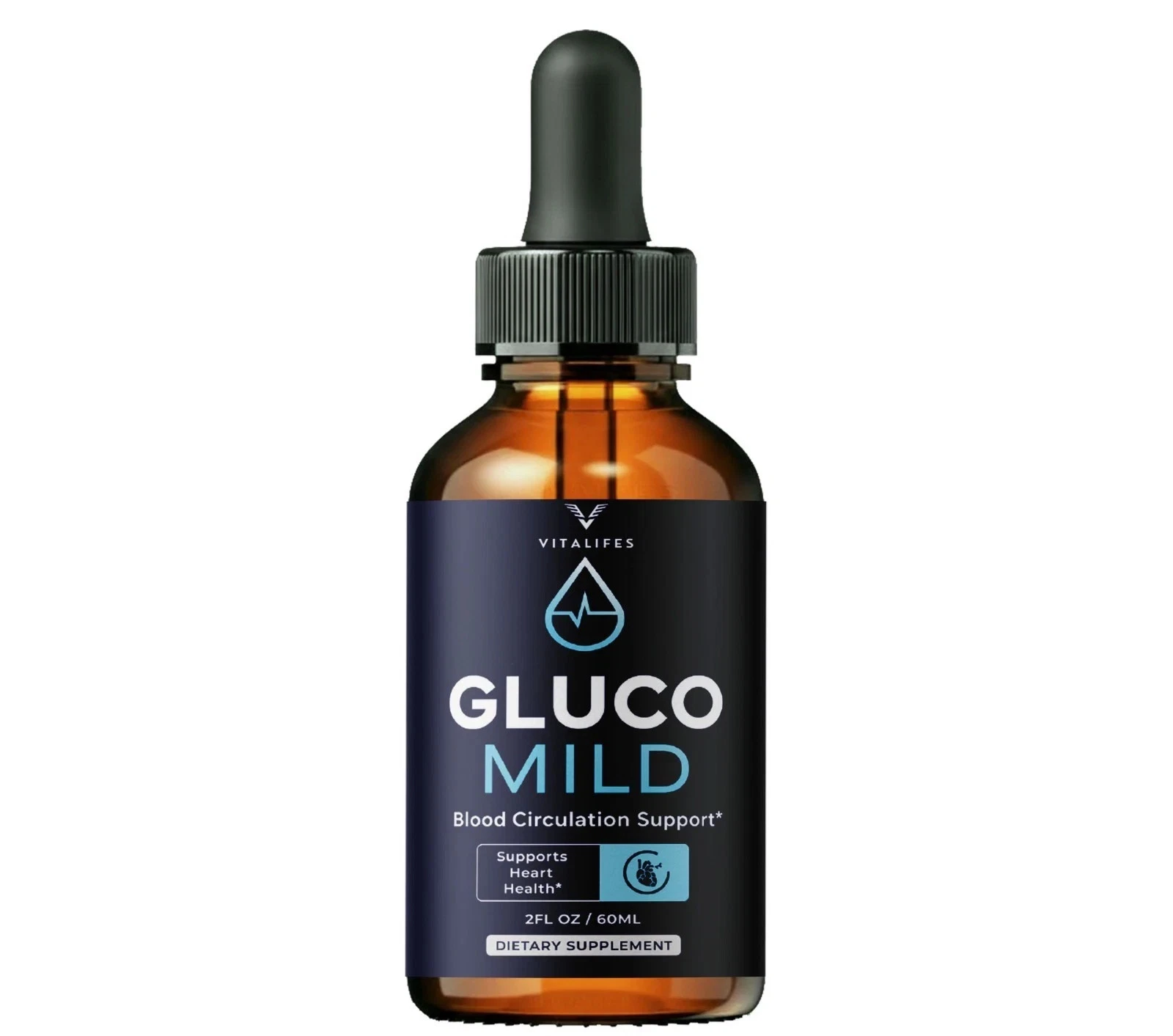
Chinese hawthorn is one of seven extracts in Gluco Mild
Seven named botanicals in a 2 fl oz amber dropper bottle, each one printed on the ingredients page beside the dose its own published trials used.
Price shown at the seller’s checkout · seller’s satisfaction money-back guarantee
Order Gluco Mild On The Official WebsiteTwo drops a day · 2 fl oz / 60 ml a bottle · lot GLU-26/GO-6518
How heart evidence gets borrowed for legs
The borrowing is rarely a lie and that is what makes it effective. It works by association rather than by assertion.
A label names hawthorn. A buyer has heard hawthorn is good for the heart. The pack says supports heart health, which is a permitted structure and function claim. Nothing false has been stated, and a reader has arrived at a conclusion the evidence does not support: that the trial results attach to this bottle.
- The trials used one named standardised extract. A label naming the plant is not necessarily carrying it.
- The successful arm ran at 1,800 mg a day. A supplement dose is often a fraction of that, and here it is unknown.
- The population had diagnosed heart failure and supervision. That is not the population reading a circulation page.
- The outcomes were exercise workload and symptom scores in a cardiac condition, not leg volume or evening swelling.
- Where an arterial measure did move, it moved in a laboratory test rather than in a day.
This website's own claims ceiling is the two lines printed on the bottle, and hawthorn is the ingredient most likely to tempt anyone past it. The benefits page stays inside those two lines deliberately, and says which ingredient each one leans on.
Two interactions that belong on the front page
Hawthorn is not a neutral plant and two findings deserve more prominence than they usually get.
An interaction study examined hawthorn alongside digoxin, the cardiac glycoside. Anyone taking a heart medicine should put a hawthorn-containing bottle in front of the prescriber before starting it, and that is a specific instruction rather than a general caution.
A meta-analysis of the hawthorn and camphor combination found that the pairing significantly increases blood pressure. That is worth knowing because it runs opposite to what a buyer would assume from an ingredient associated with cardiovascular support, and because combination products are common.
Anyone taking an anticoagulant, a heart medicine or a blood pressure medicine. The interaction is specific and named rather than a general hedge, and it is the one circumstance where a conversation with a prescriber comes before a first dose rather than after it.
What this bottle can and cannot claim from any of it
Chinese hawthorn fruit is the second name on this product's ingredient artwork. No standardisation is stated, no extract is named and no amount is printed, because this pack has no Supplement Facts panel at all.
So the position is the same as for horse chestnut, and it is the position this whole website keeps arriving at. A well-chosen ingredient with a real literature sits on a label that supplies none of the three things needed to connect the two.
What the bottle does claim is modest and inside the line: blood circulation support, and supports heart health, both with the structure and function marker. Neither sentence borrows the trial results, and neither mentions exercise workload or heart failure.
Four questions for any hawthorn label
- Which part: fruit, leaf or flower? The trials used specific preparations and the parts are not interchangeable.
- Is a standardised extract named? That is the difference between the trial literature applying and not applying.
- How many milligrams a day, and how does that compare with 1,800?
- Does the packaging claim anything about heart failure or exercise capacity? If it does, it has stepped outside what a supplement may say.
On this bottle: fruit is named, no extract is named, no amount is given, and the claims stay inside the line. Two of four are answered and the two that matter for dose are not. The category guide runs the same four questions across every plant on the list.
A dietary supplement for healthy adults of 18 and over. Not a medicine and not FDA-approved. It is sold as blood circulation and heart health support, which are structure and function claims rather than statements about any diagnosed condition. Nothing here treats, cures or prevents heart failure or any other disease.
References
- Pittler MH, Guo R, Ernst E. Hawthorn extract for treating chronic heart failure. Cochrane Database Syst Rev. 2008;2008(1):CD005312. PMID 18254076. https://pubmed.ncbi.nlm.nih.gov/18254076/
- Tauchert M. Efficacy and safety of crataegus extract WS 1442 in comparison with placebo in patients with chronic stable New York Heart Association class-III heart failure. Am Heart J. 2002;143(5):910-5. PMID 12040357. https://pubmed.ncbi.nlm.nih.gov/12040357/
- Holubarsch CJ, Colucci WS, Meinertz T, Gaus W, Tendera M. The efficacy and safety of Crataegus extract WS 1442 in patients with heart failure: the SPICE trial. Eur J Heart Fail. 2008;10(12):1255-63. PMID 19019730. https://pubmed.ncbi.nlm.nih.gov/19019730/
- Holubarsch CJF, Colucci WS, Eha J. Benefit-risk assessment of Crataegus extract WS 1442: an evidence-based review. Am J Cardiovasc Drugs. 2018;18(1):25-36. PMID 29080984. https://pubmed.ncbi.nlm.nih.gov/29080984/
- Tankanow R, Tamer HR, Streetman DS, et al. Interaction study between digoxin and a preparation of hawthorn (Crataegus oxyacantha). J Clin Pharmacol. 2003;43(6):637-42. PMID 12817526. https://pubmed.ncbi.nlm.nih.gov/12817526/
- Csupor D, Viczian R, Lantos T, et al. The combination of hawthorn extract and camphor significantly increases blood pressure: a meta-analysis and systematic review. Phytomedicine. 2019;63:152984. PMID 31255877. https://pubmed.ncbi.nlm.nih.gov/31255877/
- Asher GN, Viera AJ, Weaver MA, et al. Effect of hawthorn standardized extract on flow mediated dilation in prehypertensive and mildly hypertensive adults: a randomized, controlled cross-over trial. BMC Complement Altern Med. 2012;12:26. PMID 22458601. https://pubmed.ncbi.nlm.nih.gov/22458601/
- Hawthorn. National Center for Complementary and Integrative Health, National Institutes of Health. https://www.nccih.nih.gov/health/hawthorn