Gluco Mild Official Website › Blog › Names And No Numbers
A Label With Names And No Numbers: What It Can Still Tell You
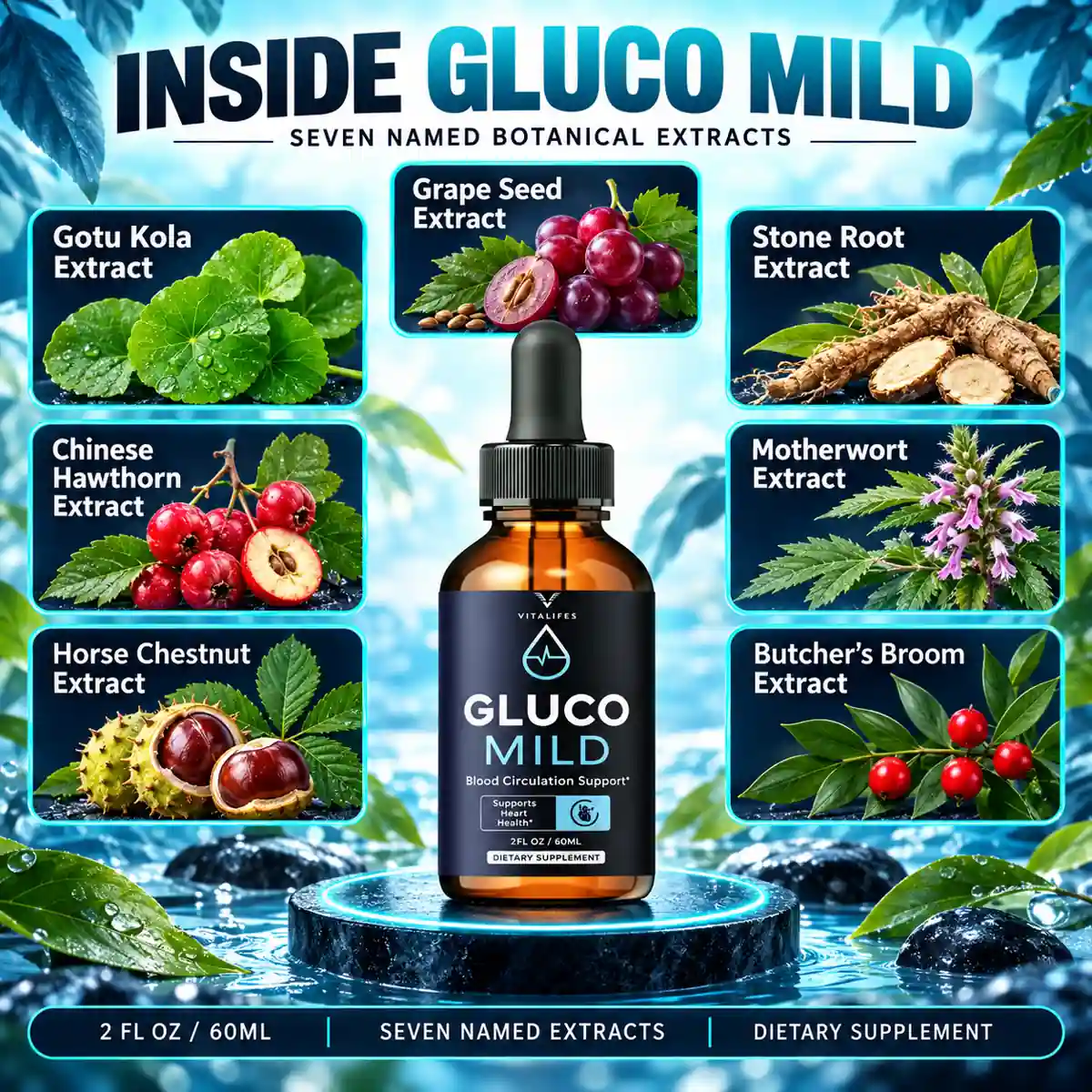
Seven botanical extracts are printed on the seller’s ingredient artwork for this bottle and not one of them carries an amount. That is a real limit on what anybody can conclude, and it is also not the end of what a careful reader can work out from the material that does exist.
- There is no Supplement Facts panel on this pack: no back label, no carton and no insert, and every bottle image in the seller's set is front-of-label.
- Seven extracts are named. No serving size, no milligram figure, no blend total, no percent daily value and no other-ingredients line appears anywhere.
- That removes the comparison this whole category turns on, because every published trial reports a dose and this bottle reports none.
- What survives is still worth reading: the plant list, the plant parts, the claim lines, the seals and the refund route can all be checked.
- Three of those four go the product's way. The list is the right list for the use case.
What a panel is actually for
A Supplement Facts panel is not decoration and not a regulatory formality. It is the document that makes a bottle comparable with anything outside itself.
Ask how a product compares with the research on its ingredients, and the answer is arithmetic against the panel. Ask what a month costs, and the answer is the serving size and the servings per container. Ask whether an ingredient is present in a meaningful quantity, and the answer is a number in a row.
Strip the panel out and none of those has an answer. What is left is a list of plants, which is a description of intent rather than of contents.
The comparison a panel makes possible
Every trial in this field reports a dose: 50 mg of aescin twice daily for horse chestnut, 1,800 mg a day of one named hawthorn extract, 60 mg twice daily for the gotu kola venous work. Those figures are published precisely so somebody can line a product up against them, and a label with a panel can be lined up in about a minute.
What is missing here, row by row
Six things a panel normally carries, and what happened to each on this pack:
| What a Supplement Facts panel prints | Why a buyer wants it | On this pack |
|---|---|---|
| Serving size and servings per container | Turns a bottle into a number of days and a cost per day | Absent |
| Each ingredient with an amount per serving | The only way to compare a product with the research behind its ingredients | Absent |
| Percent Daily Value where one exists | Puts a vitamin or mineral amount in context against a reference intake | Absent |
| A proprietary blend total, when a blend is used | A ceiling: no ingredient inside the blend can exceed it | Absent |
| The other-ingredients line | Carrier, preservative, sweetener, allergen and capsule material | Absent |
| Manufacturer or distributor name and address | Somebody to write to when something is wrong | Present, on this website and in the order paperwork |
Five rows a panel normally supplies and one that survives elsewhere. The pack has no back label, no carton and no insert to carry any of them.
The last row is the one that survives, and it is not nothing: a named distributor, a published order desk and two addresses. The contact page sets out which route can act on what.
Is this worse than a proprietary blend?
Proprietary blends have a poor reputation and most of it is earned. A blend gives one total for several ingredients, so an individual amount inside it is unknowable and the first ingredient could account for nearly all of the total.
But a blend does one useful thing, and a label with no panel does not do it. A blend total is a ceiling. If a blend is 400 mg, then no ingredient inside it exceeds 400 mg, and that single fact rules out a great deal. A bottle with no panel has no ceiling: there is no figure anywhere that any ingredient can be checked against.
| Kind of label | What you can check | What you cannot |
|---|---|---|
| Every active quantified | Each amount against each trial dose; cost per milligram; whether a row is a token | Whether the extract matches the studied form, unless it is standardised |
| A proprietary blend with a total | The ceiling on every ingredient in the blend; the blend against the trial doses | Any individual amount inside the blend |
| Names only, no panel | That the ingredients suit the use case, and how many there are | Any amount, any ratio, any comparison with any trial |
| No ingredient list at all | Nothing | Everything |
Four tiers. This bottle is on the third, which is one step above the worst case and two below what the research requires.
So on how much a buyer can verify, a blend with a printed total sits above a label with names only. That is an uncomfortable ranking for a product on the lower rung.
It does not mean the bottle is empty or that the extracts are present in trivial quantities. Nothing on this website says either, because nothing on this website knows either. A formula can be generously made and badly documented, and from the outside those two look identical. Documentation is the part a buyer can act on.
Five things that are still checkable
A missing panel closes one door and leaves several open. These five can all be verified from the material that does exist:
- Whether the plant list suits the use case. It does. Gotu kola, hawthorn, horse chestnut, stone root, motherwort, butcher's broom and grape seed are the textbook venous-tone set, and five of the seven have human trials behind them.
- Which plant parts are named. Five of the seven carry the part in brackets: gotu kola leaf, hawthorn fruit, stone root, butcher's broom root and grape seed. That is better than a good deal of this shelf manages.
- What the label claims. Two lines, both carrying the structure and function marker: blood circulation support, and supports heart health. Neither goes past what a supplement may say.
- What the seals cover. Four badges on the pack, describing a factory, an ingredient origin and a returns promise. None of them claims to be a test of the formula, and the testing page audits them one at a time.
- Whether there is a way to get your money back. A published telephone number and a named returns address, with the window shown at the checkout rather than on the seal.
Three of those five go the product's way. The formula reads like somebody who had read the venous literature chose the plants, and then nobody wrote down how much went in.
See every Gluco Mild extract beside the dose its trials used
Seven named botanical extracts, five of them with a human venous record, and the published trial figure printed next to each one.
Price shown at the seller’s checkout · seller’s satisfaction money-back guarantee
Order Gluco Mild On The Official WebsiteTwo drops a day · 2 fl oz / 60 ml a bottle · lot GLU-26/GO-6518
Four things that are not
The other side of the ledger is shorter and heavier.
- Whether any amount matches its research. This is the whole of the comparison this category is judged on and it is unavailable.
- Whether the extracts are standardised, and to what. The horse chestnut trials used an aescin-standardised seed extract. The hawthorn trials used one specific extract. Neither is claimed on this label, and neither can be ruled in or out.
- What a day actually costs. Two drops a day from a 60 ml bottle is a different arithmetic from the 2 ml the seller's listing names, and those two directions contradict each other.
- What else is in the liquid. No other-ingredients line means no carrier, no preservative and no sweetener is disclosed.
The second of those four has a safety edge as well as an evidence edge, and it is the one worth carrying away. NCCIH states that raw horse chestnut seeds, bark, flowers and leaves are unsafe taken by mouth because they contain a toxic component; the trials used standardised extracts with that component removed. A label naming the plant without saying which it contains has left out the distinction the safety record turns on.
Why the gap matters more in this category than most
Circulation botanicals are unusually dose-sensitive, and there is a published demonstration of it rather than an assertion. In the hawthorn dose comparison, 1,800 mg a day of a standardised extract beat placebo on exercise workload over sixteen weeks and the 900 mg arm of the same trial did not. Same plant, same extract, same protocol, half the amount, and the result disappeared.
That is the argument for panels in one experiment. When halving a dose can turn a positive trial into a null one, a label that will not say what the dose is has not given a reader enough to form any expectation at all.
The Cochrane review of phlebotonics sets the ceiling for the whole class: moderate-certainty evidence of a slight reduction in oedema. A category with a modest effect at known doses has little room for an unknown one.
Four changes that would close it
Criticising an absence is easy; saying what would satisfy the criticism is harder. Four changes would, in descending order of value:
- Print a Supplement Facts panel. One back label with a serving size and seven rows would answer more questions than everything else on this list combined.
- Standardise and say so. Aescin percentage for the horse chestnut, a named extract for the hawthorn, a titration figure for the gotu kola. Those three turn the published trials into evidence about this bottle rather than about the plants in general.
- Settle the serving. One direction, printed on the bottle, agreeing with the listing. At present the two differ by roughly fortyfold.
- Publish an other-ingredients line. A liquid has a carrier, and anybody avoiding alcohol, glycerine or a particular sweetener currently has no way to check.
None of the four is difficult or expensive. They are the ordinary furniture of a supplement label, which is what makes their absence a decision.
Five questions worth asking of any panel-free label
Labels with names and no numbers turn up across the shelf, and five questions sort them quickly.
- Is there a panel anywhere in the material, including the carton and any insert? Some sellers photograph only the front.
- If not, is there a blend total, which at least sets a ceiling?
- Are plant parts named? A label careful about parts is often careful in other ways.
- Is any extract standardised, and to what marker? That is the bridge between a trial and a bottle.
- Is there a published telephone number and a named returns address? That is what makes a bad purchase recoverable.
On this bottle the answers run: no panel anywhere, no blend total, five of seven parts named, no standardisation stated, and yes to both halves of the refund route. Two of five go the right way, and the checklist guide runs the full seven-point version of the same exercise.
A dietary supplement for healthy adults of 18 and over, sold as blood circulation and heart health support. Not a medicine, and not FDA-approved, because nothing in this category is. The name contains the word gluco and the label does not: nothing printed on the bottle mentions glucose, blood sugar, insulin or A1c, and no page on this website claims an effect on any of them.
References
- Diehm C, Trampisch HJ, Lange S, Schmidt C. Comparison of leg compression stocking and oral horse-chestnut seed extract therapy in patients with chronic venous insufficiency. Lancet. 1996;347(8997):292-4. PMID 8569363. https://pubmed.ncbi.nlm.nih.gov/8569363/
- Tauchert M. Efficacy and safety of crataegus extract WS 1442 in comparison with placebo in patients with chronic stable New York Heart Association class-III heart failure. Am Heart J. 2002;143(5):910-5. PMID 12040357. https://pubmed.ncbi.nlm.nih.gov/12040357/
- Horse Chestnut. National Center for Complementary and Integrative Health, National Institutes of Health. States that the raw seeds, bark, flowers and leaves are unsafe taken by mouth because they contain a toxic component. https://www.nccih.nih.gov/health/horse-chestnut
- Martinez-Zapata MJ, Vernooij RW, Simancas-Racines D, et al. Phlebotonics for venous insufficiency. Cochrane Database Syst Rev. 2020;11(11):CD003229. PMID 33141449. https://pubmed.ncbi.nlm.nih.gov/33141449/
- Navarro V, Avula B, Khan I, et al. The contents of herbal and dietary supplements implicated in liver injury in the United States are frequently mislabeled. Hepatol Commun. 2019;3(6):792-794. PMID 31168513. https://pubmed.ncbi.nlm.nih.gov/31168513/
- Using Dietary Supplements Wisely. National Center for Complementary and Integrative Health, National Institutes of Health. https://www.nccih.nih.gov/health/using-dietary-supplements-wisely
- Dietary Supplements: What You Need to Know. Office of Dietary Supplements, National Institutes of Health. https://ods.od.nih.gov/factsheets/WYNTK-Consumer/
- Questions and Answers on Dietary Supplements. U.S. Food and Drug Administration. https://www.fda.gov/food/information-consumers-using-dietary-supplements/questions-and-answers-dietary-supplements